1T Memory Cell
The positive logic operation provides 1T memory cell
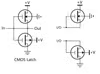
Basically, the CMOS latch is made of two memory cells, one N type and one P type; the N type cell locks the H state while the P type cell locks the L state.
We can even slice a CMOS latch into two halves as shown below to get two 1T memory cells to replace the time-consuming capacitor memory cell to greatly cut the costs of DRAM IC.
To make Depletion MOSFET into 1T memory cell, we need to tie the gate terminal and drain terminal together as the input/output terminal, and tie the source terminal and substrate terminal to the two opposite ends of power supply system respectively.
VCT (Vertical Channel Transistor) has been used as the memory cell in the DRAM IC since 2009. It is the channel of depletion MOSFET that rises above the substrate vertically. The top is the Source and the bottom is the Drain, which is also the Gate since the Gate is shorted the Drain.
The circuits to use a depletion MOSFET as a single-transistor memory cell were invented by Wen T. Lin in 2007 and were just one of the circuits to operate a depletion MOSFET as a digital switch as taught in the US patent 7,817,459. Take the N type as the example.
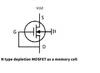
The Source is tied to the Power Supply of Vdd. Since the High state at the Drain is latched to the Source, it will remain at Vdd forever. And the Low state at the Drain is the potential of the Substrate, which can remain at the voltage of Ground forever as long as the Drain is far away from the Power Supply.
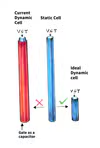
As a result, a depletion MOSFET with a tubular channel to keep the Drain far away from the Source is a static cell that can retain both states forever as long as the power remains ON.
However, if the physical location of the Drain is close to the Power Supply, in other words, the tubular channel is shorten, the potential at the Substrate where the Drain is located might fluctuate due to the leakage current through the channel so that the voltage at the Drain needs to be refreshed periodically. And it becomes a dynamic cell.
Since a shorter channel can be fabricated with much less time and material, it is justified to implement the additional circuitry needed to refresh a dynamic cell. And it is the right way to turn a static cell into a dynamic cell.
Unfortunately, all the current dynamic cells in DRAM IC achieve this goal by adding an unwanted Gate as a capacitor to induce the leakage current and is outrageously wasteful as a result.